Showing posts with label ekphrastic poetry. Show all posts

29 September 2016

Poem: The Cliff

The Cliff
(after Anselm Kiefer)


I make a lexicon       of things that can be        white

         linen             lace        sea foam           face

but these     small dresses      nightshirts   doll-sized robes
    
       are spattered               grey     and        maculate

stone ghosts of birds            snagged       on a wall of ash


I wonder                 how they           were stitched

smock       shirr         pick         cross               feather

        but it’s                   impossible             to tell

their seams           have rotted               in the spray


I think      how they once were cut     from patterns

        facing    yoke    placket     pocket        welt

but the waves   have flung      this flock of empty children
      
         against                           a squalling bluff     

all memory of making                           has been lost


Above the cliff  the sky            is cracked like mud

I make a lexicon of things     that are        unravelled


Sally Douglas


'The Cliff' was a prizewinner in the 2015 Exeter Poetry Festival Competition, and was originally published in the Festival pamphlet, Threads.

9 June 2016

Nana on a Dolphin and other poems...

I'm delighted to have three poems featured at Exeter University's poetry journal, Canto. One is a response to Niki de St Phalle's wonderful 'Nana on a Dolphin'; one has its roots in Russia, and another was described on Twitter by WN Herbert as 'a fine elegiac poem about eyebrows'. (Thank you!) You can now read the poems here.

To whet the appetite, here are a couple of related images:


Grinling Gibbons Hampton Court.JPG
A carving by Grinling Gibbons

By Camster2 - Own work, CC BY-SA 3.0, https://commons.wikimedia.org/w/index.php?curid=6521009

Nana On A Dolphin.jpg
Nana on a Dolphin, by Niki de St Phalle

By Source, Fair use, https://en.wikipedia.org/w/index.php?curid=30813065

30 November 2015

Ekphrastic Prompt 7 - The Rucksack by David Inshaw

DAVID INSHAW The Rucksack (Anticipation) 1994 1995
The Rucksack (Anticipation) by David Inshaw


Today's prompt is a picture by the British artist David Inshaw. Inshaw was a member of the Brotherhood of Ruralists, a group which included Peter Blake, Jann Haworth, Graham and Annie Ovenden, and Graham and Ann Arnold. It was formed in 1975 and placed itself 'in opposition to the scholarly nature of contemporary art which believed that paintings were only really valid if they addressed social questions' (Peter Blake).

I first came across the Brotherhood of Ruralists when in the late '70s my parents bought a pencil drawing by Graham Ovenden, but I know a lot more of their work from the front covers of the second edition Arden Shakespeares that I still have on my shelves.

But back to the image. There's a lot here that could grow into a poem. The rucksack of the title which is barely in the picture; those gulls all looking in the same direction; the white towels; the hidden face; the strangely claustrophobic landscape. 

Perhaps you'd like to bounce this image off another poem. Have a look at Matthew Arnold's 'Dover Beach', or Les Murray's 'On Home Beaches' where 'You peer, at this age, but it's still there, ridicule,/ the pistol that kills women, that gets them killed, crippling men/ on the towel-spattered sand.' Think about the contrasts and the potential confluences. Think about your own experiences around beaches and coastlines.

You can see more of David Inshaw's work, his intense, often erotic and sometimes almost surreal pastoralism, on his website here; and an article about him in The Guardian, here

Happy viewing, and happy writing. 


Image Credit: The Rucksack. By David Inshaw (the artist) [CC BY-SA 3.0 (http://creativecommons.org/licenses/by-sa/3.0)], via Wikimedia Commons

26 November 2015

Ekphrastic Prompt 6: The Mask of Agamemnon

MaskOfAgamemnon.jpg
Mask of Agamemnon

Isn't this an amazing image? A golden mask, life-sized, flattened, with eyes which are at the same time open and closed. Beard, eyebrows, ears, hammered and chased into fine detail - simultaneously naive and strangely sophisticated.

This mask was discovered in 1876 by Heinrich Schliemann, a C19th German businessman who became a famous treasure hunter/archaeologist, and is now in the National Archaeological Museum of Athens. Schliemann had previously excavated the remains of Troy, where, as told in Homer's Iliad, an epic ten year war was fought between the Greeks and the Trojans. The leader of the united Greek armies was Agamemnon, the king of the Mycenaeans, whose brother's wife, Helen, had been abducted by the Trojan prince, Paris.

When Agamemnon returned from the war, the legend is that he was killed by his own wife's lover, Aegisthus, or perhaps even by his wife Clytemnestra herself. This mask was found in a royal grave at Mycenae, and Schliemann was convinced that it was the death mask of Agamemnon himself, although some have claimed it to be a fake, and some archaeologists now believe it pre-dates the Trojan War by several hundred years. It is made of beaten gold, with the fine details chased out using a sharp tool. It is an amazing artefact. I saw it in Athens nearly thirty years ago when backpacking around Europe and it remains an iconic memory for me.

Today's prompt is to take this mask as a starting point for a poem. There are so many directions in which it could take you! You could just think about masks in any or all of their forms; you could concentrate on Agamemnon and his story; you could think about Schliemann; you could explore ideas of real and fake. You could even link back to what is often considered the first piece of ekphrastic writing: the description of The Shield of Achilles' in Book 18 of The Iliad.

If you are interested in some background, there's an interesting discussion here, and an article about the authenticity question here.

If you fancy reading or rereading The Iliad the translation by Richmond Lattimore is the one to go for.

And here's what Google has to say about the word 'mask':

mask
mɑːsk/
noun
noun: mask; plural noun: masks; noun: masque; plural noun: masques
  1. 1.
    a covering for all or part of the face, worn as a disguise, or to amuse or frighten others.
  2. 2.
    a covering made of fibre or gauze and fitting over the nose and mouth to protect against air pollutants, or made of sterile gauze and worn to prevent infection of the wearer or (in surgery) of the patient.
    synonyms:mattephotomaskshadow mask, masking, masking tape
    "a mask that blocks out part of the image"
    • a protective covering fitting over the whole face, worn in fencing, ice hockey, and other sports.
      synonyms:face mask, protective mask, gas maskoxygen mask, fencing mask,iron mask, ski mask, dust mask; More
    • a respirator used to filter inhaled air or to supply gas for inhalation.
  3. 3.
    a face pack.
    "this exfoliating mask helps clear your pores and leaves your skin feeling soft and healthy"

  4. 4.
    a likeness of a person's face moulded or sculpted in clay or wax.
  5. 5.
    a manner or expression that hides one's true character or feelings.
    "I let my mask of respectability slip"
    synonyms:pretencesemblanceveilscreenfront, false front, facadeveneer,blind, false colours, disguiseguiseconcealmentcovercover-up,cloakcamouflage
    "de Craon had dropped his mask of good humour"

  6. 6.
    PHOTOGRAPHY
    a piece of material such as card used to cover a part of an image that is not required when exposing a print.
  7. 7.
    ELECTRONICS
    a patterned metal film used in the manufacture of microcircuits to allow selective modification of the underlying material.
  8. 8.
    ENTOMOLOGY
    the enlarged labium of a dragonfly larva, which can be extended to seize prey.
verb
verb: mask; 3rd person present: masks; past tense: masked; past participle: masked; gerund or present participle: masking

  1. 1.
    cover (the face) with a mask.
    "he had been masked, bound, and abducted"
    synonyms:hideconcealdisguise, cover up, obscurescreencloakcamouflage,veilmantleblanketenshroud
    "people carried herbs to mask the stench"
    antonyms:enhancereinforce
  2. 2.
    conceal (something) from view.
    "the poplars masked a factory"
    synonyms:hideconcealdisguise, cover up, obscurescreencloakcamouflage,veilmantleblanketenshroud
    "people carried herbs to mask the stench"

    antonyms:enhancereinforce

  3. 3.
    cover (an object or surface) so as to protect it during painting.
    "mask off doors and cupboards with sheets of plastic"
    synonyms:mattephotomaskshadow mask, masking, masking tape
    "a mask that blocks out part of the image"

Origin

mid 16th century: from French masque, from Italian mascheramascara, probably from medieval Latin masca ‘witch, spectre’, but influenced by Arabic masḵara ‘buffoon’.


Image Credit: "MaskOfAgamemnon" by Xuan Che - Self-photographed (Flickr), 20 December 2010
Licensed under CC BY 2.0 via Commons.

Definition Credit: Google

25 November 2015

Art from poetry/poetry from art: blueshift

I've just had the pleasure of reviewing this lovely pamphlet, a linked sequence of original art and poetry responses, at Abegail Morley's Poetry Shed. You can read the review here, and purchase the book here. It's beautiful, and would make a lovely Christmas present for anyone who likes art or poetry! 

The poets and artists featured in the pamphlet are:

Stephanie Arsoska
Becky Cherriman
Claire Collison
Karen Dennison
Sheena Drayton
Lizanne van Essen
Saras Feijoo
Tessa Frampton
Rebecca Gethin
Pam Job
Pete Kennedy
Agnes Marton
Sam Smith
Emmy Verschoor

20 November 2015

Ekphrastic Prompt 5: In Your Own Background

Pieter Bruegel de Oude - De val van Icarus
'Landscape with the Fall of Icarus', Bruegel

One of the most famous poems which responds to a work of art is Auden's 'Musee des Beaux Arts', which famously zooms in on and out from the figure of Icarus falling to his death in Pieter Bruegel the Elder's 1558 'Landscape with the Fall of Icarus'. Icarus is a tiny figure, and Bruegel's genius is in the way in which this strange death is situated in the 'everydayness' of a C16th landscape, where, in Auden's words
...the expensive delicate ship that must have seen
Something amazing, a boy falling out of the sky,
Had somewhere to get to and sailed calmly on.
This made me think of other pictures by Bruegel - those crowd scenes where all those ordinary people must also have their stories that no one else knows or cares about. And paintings by other artists: the people in background of Ford Madox Brown's 'The Last of England', or the followers in Gozzoli's Procession of the Magi, a picture full of ordinary people who are not the main focus of the image.

Gozzoli magi
Gozzoli's 'Procession of the Magi'

But today's prompt does not use a painting by a famous artist. It uses an image created by you.

Most people take photos - if you are anything like me, you take quite a lot! And when you are on holiday, focussing your camera on a building, or a church, or your child playing on the beach, you quite often take pictures which contain people you don't know. Have a look at your holiday snaps; find one with strangers in it. If it's a digital photo on your computer, zoom in on someone. If it's not digital, you'll just have to make your eyes work a bit harder. Is there someone there who looks out of place? Someone whose expression hides something? That's your springboard, your Icarus. Write about that person, that crowd, that location. Write about your relationship with that person - because you have one now, now that you've noticed them. Or think of it another way - what if you were the stranger in someone else's holiday snaps?

So this prompt is a kind of echoing ekphrasis, springboarding you, as writer, off the Auden/Breugel motif of people unaware or uninterested in what is happening in the background to their lives, to find the people you didn't notice in a day in your own life. Could be interesting!


With thanks to Sally Flint, whose suggestion to write a poem from an image of someone you don't know led me to this idea. 


.

15 November 2015

Old, New, Borrowed, Blue: Four Recommendations

Old


Everybody should have at least a passing acquaintance with Ovid. Ever since I was a small child, reading Enid Blyton's Tales of Long Ago, I have been fascinated by these tales of transformation, and even went on to study Metamorphoses in the original Latin at university. This new(ish) verse translation by David Raeburn is very good. Of course, Ted Hughes's Tales from Ovid is just fabulous, but it only contains a selection from the original. I say, read both!

Ovid, Metamorphoses, tr. David Raeburn, Penguin, 2004
Tales from Ovid, Ted Hughes, Faber, 1997

New


Jos Smith's pamphlet from Maquette Press draws on eyewitness accounts of the 1967 Torrey Canyon oil spill to create a collection of poems that celebrate and mourn, witness and remember. You can read my review of it here, at Canto Poetry.

A Plume of Smoke, Jos Smith, Maquette Press, 2015

Borrowed


I came across this anthology while doing an excellent Poetry School course on ekphrastic poetry tutored by Sally Flint. Unfortunately the book is no longer in print, but it is available second hand and very cheaply at a certain online bookseller. It is a collection of C20th poetry from the UK, North America and Europe, and the pieces of art to which these poets are responding. Poetry borrowing from art - and, I think, repaying with interest.

Voices in the Gallery, ed. Dannie and Joan Abse, The Tate Gallery, 1986


Blue


Blue because the cover illustration is mostly blue, and there is a lot of water in the book! 

As Bill Greenwell says on the back of this stunning collection: 'A Handful of Water is... composed, meditative, inquisitive, tender... The verbal invention is exceptional... Every poem turns up sudden surprises, wonderful delights'. Rebecca Gethin's subject matter ranges over landscape, World War I soldiers, prisoners and their visitors, animals and people, all delicately observed and richly realised.

A Handful of Water, Rebecca Gethin, Cinnamon Press, 2013

14 November 2015

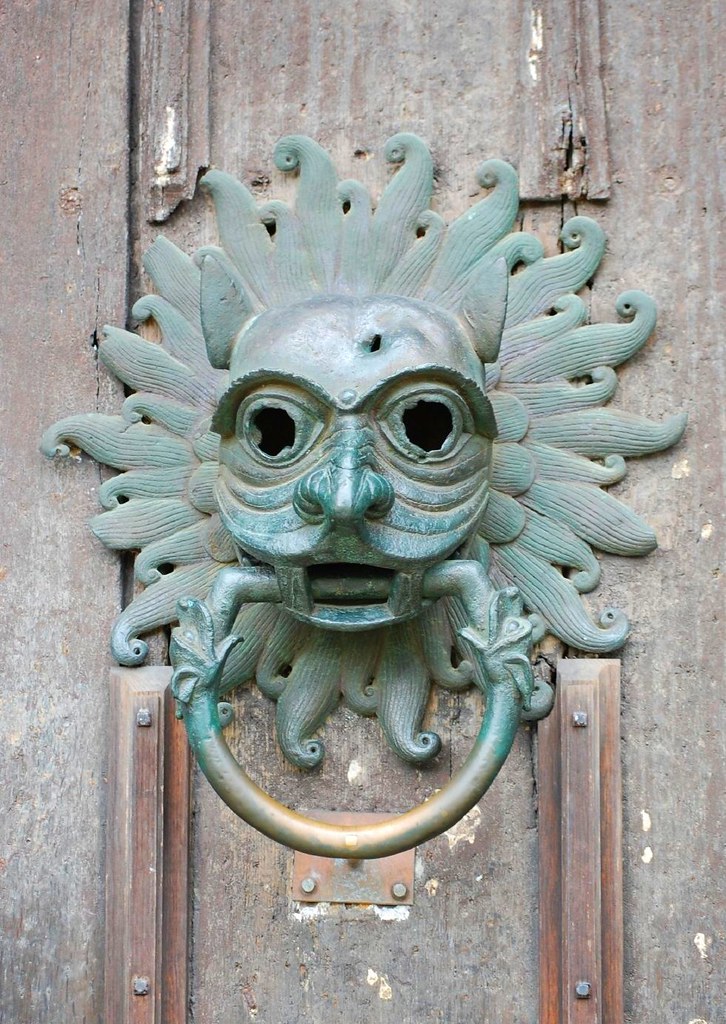
Ekphrastic Prompt 4: Sanctuary Knocker, Durham Cathedral

Sanctuary Knocker, Durham Cathedral
Sanctuary Knocker, Durham Cathedral 


This massive bronze knocker on the North door of Durham Cathedral was intended to enable people who had 'committed a great offence' to ask for sanctuary within the Cathedral. There were originally two small chambers above the doorway where monks would keep watch, ready to let a sanctuary seeker in at any time of day or night. The sanctuary seeker would have to change into black robes with the yellow cross of St Cuthbert printed on the shoulder, and was kept in an enclosure separate from the rest of the church. He (or she - I assume women were allowed to seek sanctuary as well, but I may be wrong) had to confess his crime, and was then fed and sheltered, but after the thirty seven days were over was escorted to a port because he was required to leave the country.

The knocker in the picture is a replica of the C12th original, which is now kept inside the Cathedral, but even this one, which is now about thirty five years old, has been subject to an attempted burglary.

I think this knocker and the possible stories behind it, the concepts of sanctuary and exile, would be a great subject for a poem, either explicitly or tangentially. There is more information at the Durham World Heritage site, and at England's North Eastand also an interesting piece about whether the knocker might be a Chinese dragon.

And as another bit of inspiration, here's the brilliant Cathedral of Salt by Nick Flynn, in Poetry Magazine. Presumably nothing to do with Durham, but a cathedral nonetheless.

Happy writing.


Image Credit: https://www.flickr.com/photos/dkohara/2735149358 http://www.durhamcityphotos.co.uk/

12 November 2015

Poem: Eye

As I've been posting a few prompts for ekphrastic poetry, I thought I'd share one of my own poems inspired by a painting. 'Eye' was written in response to Howard Hodgkin's 'Love Letter', which you can see here. I liked this image as a prompt because it is so open, so full of possibility, and a poem could move outwards from it without (I hope) undermining it. I wrote this a few years ago, and looking at it now, although I'd probably write a different poem today I still like it enough to share it.


9 November 2015

Ekphrastic Prompt 3: Crocodiles

Cocodrilo, Paseo de la Reforma.jpg
Image 1: 'How doth the little crocodile', Leonora Carrington


Crocadiles.jpg
Image 2: A bask of real crocodiles

Write a poem about a crocodile. Or not about a crocodile. Or about the crocodile's teeth, or its tail, or its unrealised ambition to be a BBC newsreader.

Here's a poem by Jonathan Edwards in the subject, and another by Kay Ryan.


Picture Credits
Image 1: "Cocodrilo, Paseo de la Reforma" by Paul Asman and Jill Lenoble - Paseo de la Reforma. Licensed under CC BY 2.0 via Commons.

Image 2: "Crocadiles". Licensed under CC BY-SA 3.0 via Commons.

5 November 2015

Ekphrastic Prompt 2: 'Seed' by Peter Randall-Page

SEED.jpg
'Seed', granite sculpture. Peter Randall-Page.

This immense granite seed stands in its own purpose-built chamber at Cornwall's Eden project. Information about its creation can be found on Peter Randall-Page's website, and there is a short film about it here at Eden.


Image Credit: "SEED" by ME - desktop. Licensed under Public Domain via Commons.

3 November 2015

Ekphrastic Prompt 1: Antony Gormley's 'Event Horizon'


London National Theatre with sculpture.jpg
Image 1


Image 2

Today's post is a writing prompt: a couple of images to use as a starting point for a poem (or two), or perhaps a piece of flash fiction. 

If you'd like to, please feel free to share your result in a comment below. 


Some more information about the artwork can be found here.


Image Credits:

Image 1: "London National Theatre with sculpture" by Todd Huffman from Phoenix, AZ - Watcher. Licensed under CC BY 2.0 via Commons.

Image 2: "Gormley-event-horizon" by WyrdLight.com. Licensed under CC BY 3.0 via Commons.